
Finding the Right Plant for Your Place
Using Our Regional Ecosystem Search
Ever wondered why a plant thrives in one part of the Coast and struggles a few kilometers away? Often, it comes down to a location's physical conditions, such as soils and underlying geology, which can influence plants so much that they form distinct vegetation communities.
The good news is, the Queensland Government has developed a system for classifying vegetation communities by location, making it easier to identify the right plants to grow in your area. This system classifies vegetation into 'Regional Ecosystems'.
Each Regional Ecosystem (RE) is identified by a three-part code:
Bioregion
(first number) — Queensland is divided into 13 bioregions.
The number 12 means South-East Queensland (SEQ).
Land Zone
(second number) — the underlying geology, soil and landform.
There are 12 land zones across the state.
Vegetation Community
(third number) — the dominant species that characterise that particular bioregion and land zone combination.
Work in Progress at the Nursery:
Each week, volunteers at the Nursery work through official Queensland Government Regional Ecosystem documentation, checking it against our own plant collection species by species and recording the correct RE codes for each one.
It's slow, detail-heavy work — there's a lot of cross-referencing involved — but it means the information going onto our website is grounded in the official records, not guesswork.
Thank you Grus :)
Search Our Plants by Regional Ecosystem
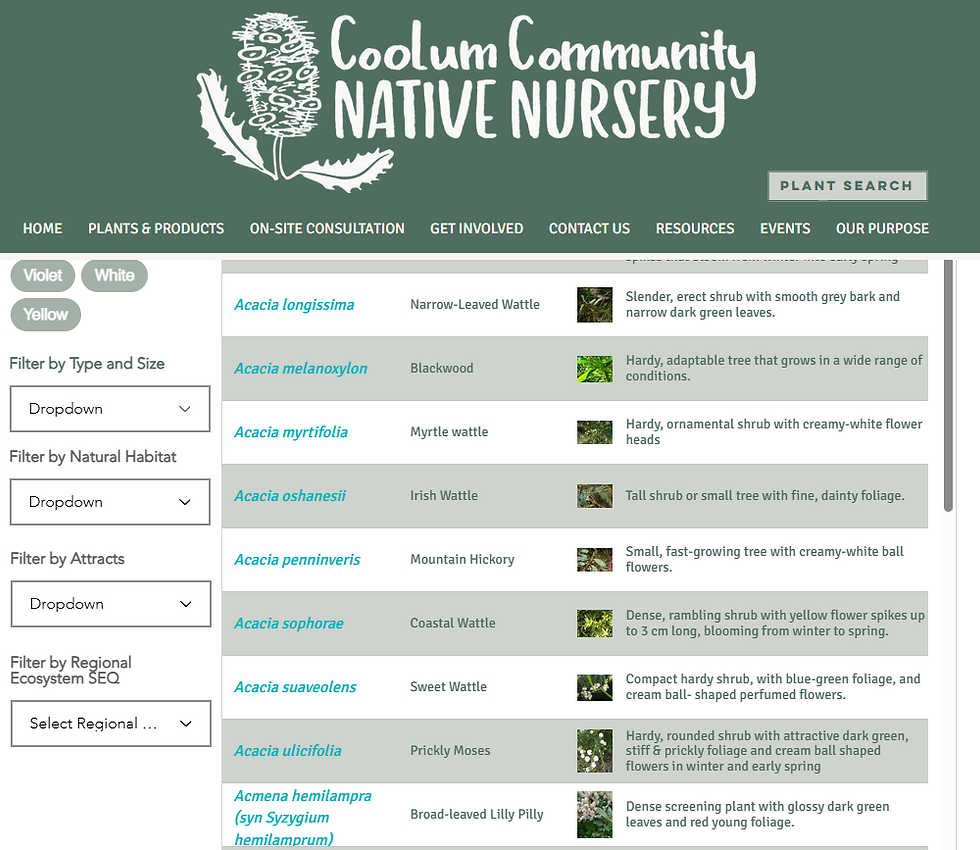
As that work progresses, it feeds straight into our online Plant Search. More plants and more complete RE information are being added every week, but there's already plenty there to use:
Visit coolumnatives.com/plant-information and use the “Filter by Regional Ecosystem SEQ” dropdown to browse plants by RE code.


Or open any individual plant page and scroll to the bottom — you’ll find its Regional Ecosystem listing, along with a direct link to the official Queensland Government description for more detail or the official documents we used to find the information.

Not sure which Regional Ecosystem your own property sits in? The Queensland Government can generate a map of your area’s Biodiversity Status or Broad Vegetation Group online: https://apps.des.qld.gov.au/map-request/re-broad-veg-group/
To read our post click here
Comments